
German vs British vs Italian Kitchens: Which Is Best?
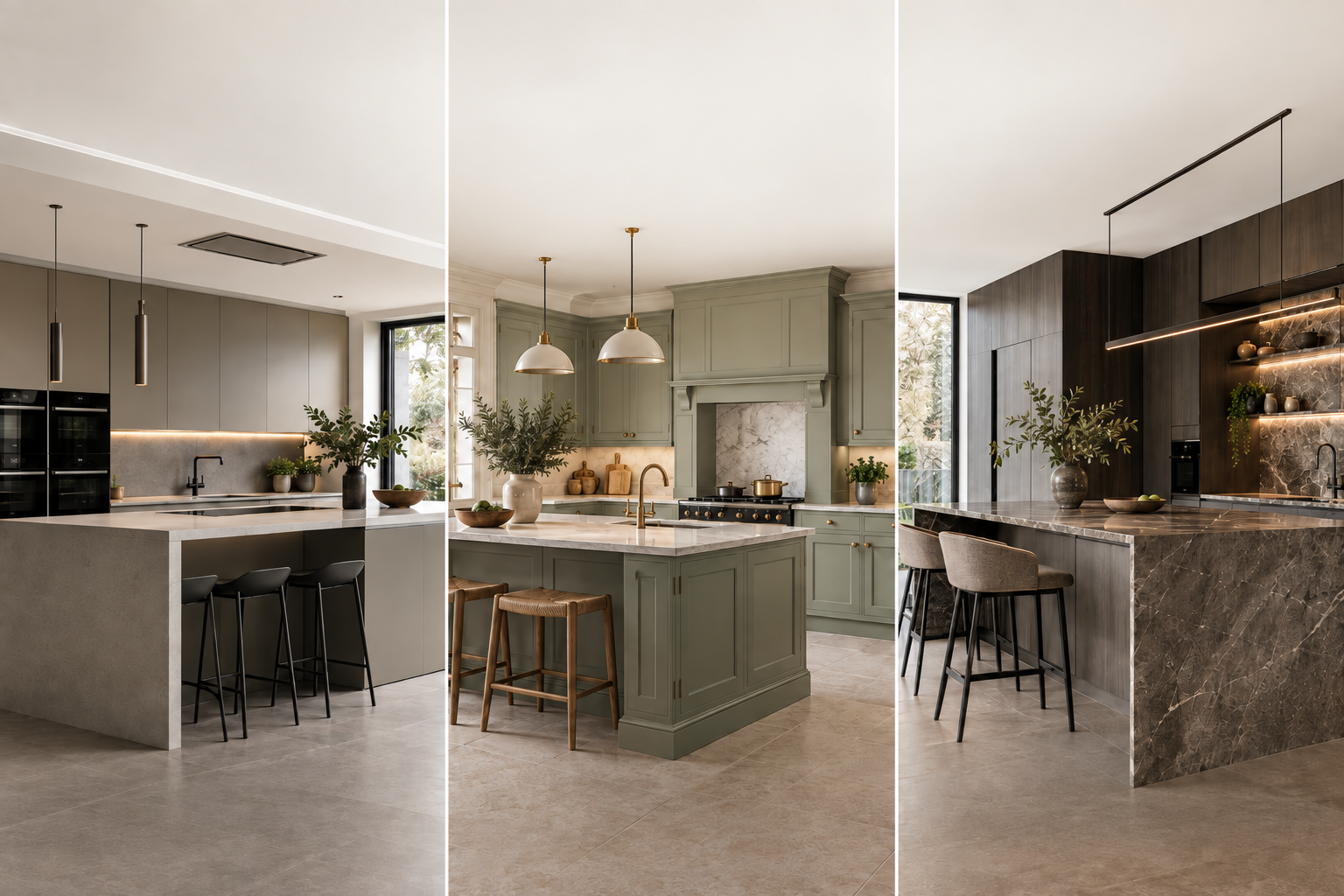
If you are planning a high-quality new kitchen, you will quickly come across three broad choices: German, British and Italian kitchens.
But is one actually better than the others?
The short answer is no. A German kitchen is not automatically better made than a British kitchen, and an Italian kitchen is not automatically more stylish than either.
Each tends to have different strengths, and the right choice depends on your home, the look you want, how you use the kitchen and the individual manufacturer.
At Atlantic Bespoke Kitchens, we work with German, British and Italian kitchen manufacturers, so our starting point is not the country of origin. It is the project itself.
German vs British vs Italian kitchens at a glance
| German kitchens | British kitchens | Italian kitchens | |
|---|---|---|---|
| Often associated with | Precision and contemporary design | Craftsmanship and traditional detailing | Design-led materials and styling |
| Particularly suited to | Handleless and modern kitchens | Shaker, painted and in-frame kitchens | Contemporary and architectural interiors |
| Typical strength | Engineered systems and clean lines | Flexibility and furniture-style detailing | Material choice and visual expression |
| Often works well in | Modern extensions and open-plan homes | Period homes and traditional interiors | Design-led homes and statement spaces |
These are broad characteristics rather than fixed rules. There is plenty of crossover between all three.
The manufacturer, specification and quality of the design matter more than the flag on the brochure.
What are German kitchens known for?
German kitchens have a strong reputation for precision manufacturing, clean detailing and contemporary design.
They are particularly popular with homeowners looking for handleless cabinetry, integrated appliances, tall banks of units and a very controlled architectural look.
The structured nature of German kitchen manufacturing can be a real advantage. Cabinet sizes, finishes and internal systems are usually developed within a clear framework, which allows a designer to create highly resolved contemporary kitchens while maintaining consistency.
That makes German kitchens particularly well suited to:
Contemporary extensions
Open-plan kitchen and living spaces
Minimalist interiors
Handleless kitchen designs
Projects with large areas of tall cabinetry
However, the phrase "German kitchen" does not guarantee quality on its own.
There are different manufacturers at different price and specification levels, so it is still important to look at the actual cabinet construction, finishes, hardware and design flexibility.
At Atlantic Bespoke Kitchens, we work with German manufacturers including Beeck, Kuhlmann and Brigitte, each with its own strengths and design language.
See our German, British and Italian kitchen ranges
What makes British kitchens different?
British kitchens cover a very wide range, from relatively standard manufactured cabinetry through to genuinely bespoke and handmade furniture.
Where British manufacturers can be particularly strong is in painted cabinetry, Shaker kitchens, in-frame construction and traditional joinery details.
This makes them a natural fit for many Victorian, Edwardian and period properties across North London and Hertfordshire.
A British kitchen can work especially well if you want:
Painted cabinetry
A Shaker or in-frame design
Traditional detailing
More furniture-like proportions
Custom or unusual cabinet sizes
A kitchen that feels sympathetic to a period home
That does not mean British kitchens have to look traditional.
A painted or in-frame kitchen can be combined with simple worktops, contemporary handles, modern appliances and restrained colours to create something that feels current without ignoring the architecture of the property.
At Atlantic Bespoke Kitchens, we work with British manufacturers including Callerton, as well as handmade cabinetry for projects where traditional construction and detailing are important.
If you are unsure about the difference between Shaker and in-frame cabinetry, we have explained it in more detail here:
Shaker vs In-Frame Kitchen: What’s the Real Difference?
What are Italian kitchens known for?
Italian kitchens are often associated with design-led interiors, interesting materials and a more expressive contemporary style.
They can appeal to homeowners who want the kitchen to feel like an architectural feature of the room rather than simply a collection of cabinets.
Italian manufacturers often place strong emphasis on combinations of materials, texture, colour and furniture-style elements.
That makes them particularly interesting for clients who want:
A contemporary kitchen with more visual character
Unusual materials or finishes
Strong architectural detailing
A statement island or feature wall
A kitchen that feels less conventional
At Atlantic Bespoke Kitchens, we work with Turi for clients looking for a more expressive, contemporary approach.
As with German and British kitchens, the quality of an Italian kitchen depends on the individual manufacturer and specification, not simply the country where it was made.
Are German kitchens better quality than British or Italian kitchens?
Not automatically.
German manufacturers have built an excellent reputation for precision and engineered systems, but high-quality kitchens are produced in Britain and Italy too.
A more useful way to judge quality is to ask:
How are the cabinets constructed?
What materials are used?
What hinges and runners are specified?
How durable are the finishes?
How much design flexibility is available?
How well is the kitchen installed?
Installation is particularly important.
A very well-made kitchen can still perform poorly if it has been badly measured, badly planned or poorly fitted.
For that reason, we would always recommend looking at the complete package rather than comparing cabinet brands alone.
Are British kitchens more bespoke?
Not necessarily.
The word bespoke is used very loosely in the kitchen industry.
Some British manufacturers offer extensive customisation, while others work within a fairly standard range of cabinet sizes. The same is true of German and Italian manufacturers.
When comparing kitchen companies, ask what bespoke actually means within their range.
Can the cabinet dimensions be changed?
Can colours be customised?
Can unusual pieces be made specifically for your room?
Or is the kitchen mainly assembled from a set collection of cabinet sizes?
These questions make it much easier to compare different kitchen quotations.
Read our guide to questions you should ask a kitchen designer
Which is best for a period North London home?
There is no single answer.
For a Victorian or Edwardian property, a British Shaker or in-frame kitchen can work beautifully because it references the proportions and detailing already present in the house.
However, a contemporary German or Italian kitchen can also work extremely well, particularly in a modern rear extension.
The choice often comes down to whether you want continuity or contrast.
If you want the new kitchen to feel connected to the original architecture, a British painted or in-frame kitchen may be a natural fit.
If you want a clear distinction between the period house and a new contemporary extension, a clean-lined German or Italian kitchen can create a deliberate contrast.
Both approaches can work well when they are properly considered.
Which is best for a contemporary extension?
German and Italian kitchens naturally suit many modern extensions because they work well with large-format glazing, open-plan layouts and simple architectural lines.
Handleless cabinetry, flush appliance walls and large islands can complement this type of space very effectively.
However, British kitchens should not be discounted.
A refined Shaker or painted kitchen can introduce warmth and character into a highly contemporary extension and stop the room from feeling too stark.
The architecture should influence the design, but it does not have to dictate the cabinet style.
Which is more expensive?
There is no reliable rule that says German, British or Italian kitchens are more expensive.
Price depends much more on:
The manufacturer
Cabinet quantity
Door and surface finishes
Customisation
Internal storage
Worktops
Appliances
Installation
A simple Italian kitchen may cost less than a heavily customised British in-frame kitchen, while a highly specified German kitchen may cost more than either.
The specification is far more important than the country of manufacture.
Read our guide to bespoke kitchen costs in London
So which should you choose?
Start with the project, not the country.
If your priority is a highly resolved contemporary or handleless kitchen, a German manufacturer may be an excellent place to start.
If you want painted cabinetry, Shaker styling or traditional in-frame detailing, a British manufacturer may be more suitable.
If you are looking for a contemporary kitchen with more expressive materials and design features, an Italian manufacturer may be worth exploring.
But these should only be starting points.
The most important factors are:
Your home.
How you use the kitchen.
Your preferred aesthetic.
The quality of the manufacturer.
The flexibility of the product.
The skill of the designer.
The quality of the installation.
This is why we work with manufacturers from all three countries.
It allows us to recommend the kitchen that suits the project rather than trying to make every project fit one range.
abinetry. However, contemporary German and Italian kitchens can also work very well in period homes, especially where they sit within a modern extension.
-
Not automatically. German kitchens are particularly strong in contemporary, engineered systems, while British manufacturers can be particularly good at painted, Shaker and in-frame cabinetry. The individual manufacturer and specification matter more than country of origin.
-
Yes, premium Italian manufacturers can produce very high-quality kitchens. They are often particularly strong in contemporary design, materials and architectural detailing.
-
They can be, particularly if you want painted, Shaker or in-frame cabinetry. However, contemporary German and Italian kitchens can also work very well in period homes, especially where they sit within a modern extension.
-
This varies by manufacturer. Some British handmade kitchens offer significant dimensional freedom, while premium German and Italian brands can also offer extensive finish and configuration options.
-
Not necessarily. The final cost depends much more on the manufacturer, finishes, cabinetry, worktops, appliances and installation than where the kitchen was made.
-
Usually, no. It is often better to understand the space, brief and design direction first. The manufacturer can then be selected to suit the project.
Choosing the right kitchen for your home
If you are deciding between a German, British or Italian kitchen, you do not need to make that choice before speaking to a designer.
At Atlantic Bespoke Kitchens, we design, supply and install kitchens from a carefully selected range of German, British and Italian manufacturers for homes across North London and Hertfordshire.
We start by understanding your property, how you live and what you want the finished kitchen to achieve.
From there, we can recommend the manufacturer, materials and specification that best suit the project.
See how our bespoke kitchen design process works
Planning a kitchen project in North London or Hertfordshire? Visit our showroom or book a design consultation to compare the options in person.
